Skip to content
Top-rated outdoor gear, ranked

Best Of 2026

Best RV Water Filters of 2026

Our top 10 picks, independently ranked. Budget to premium.

Water quality changes every time you move the rig. One park runs heavily chlorinated city water, the next pulls from a well that carries sand, iron, and a sulfur smell, and a third has clean source water flowing through fifty-year-old park plumbing that sheds sediment every time a line gets repaired. If you live in your RV or park it in one spot for months at a time, that variability becomes a daily quality-of-life issue: it stains fixtures, clogs your water heater, shortens the life of your pump, and decides whether you actually drink from your own tap.

The market splits into three clear tiers, and knowing which one you are shopping saves money on both ends. Disposable inline sticks in the $20 range screw onto any hose and mostly fix chlorine taste and odor. Canister systems from roughly $25 to $190 add replaceable cartridges and true sediment staging, which works out cheaper per season for anyone filtering daily. Premium multi-stage systems from $450 to $900 bring hospital-grade 0.2 micron absolute filtration, stainless fittings, and flow rates high enough that you forget the filter is there. The extra money buys tighter filtration without the pressure loss that makes cheap tight filters unlivable.

This guide covers ten filters we verified as real, currently available products spanning that whole spectrum. Weekenders can stop at the budget tier and be happy. Full-timers and long-term park residents should read the mid and premium tiers closely, because cartridge economics and flow rate matter far more when the filter runs 365 days a year.

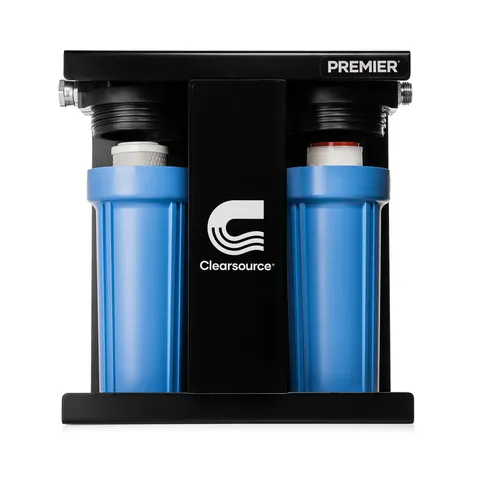
Clearsource Premier RV Water Filter System
Best OverallPremium

1. Clearsource Premier RV Water Filter System

Clearsource

$450–$500

Two oversize canisters, stainless fittings, and a hospital-grade 0.2 micron absolute second stage put real pathogen protection on your water line without choking flow. At 6 gpm or better, it is the rare serious filter a full-timer never notices in the shower.

Best for: Full-timers and long-term park residents who want the best protection-to-flow balance available

0.2 micron absolute second stage removes bacteria like E. coli and Legionella plus cysts like giardia · 6 to 6.5 gpm flow keeps showers and tank fills at full speed · Stainless steel fittings and oversize canisters built for years outdoors · Cartridge refills cost less per season than disposables for daily use

Roughly $500 up front · 24 pounds and bulky to stow if you move often

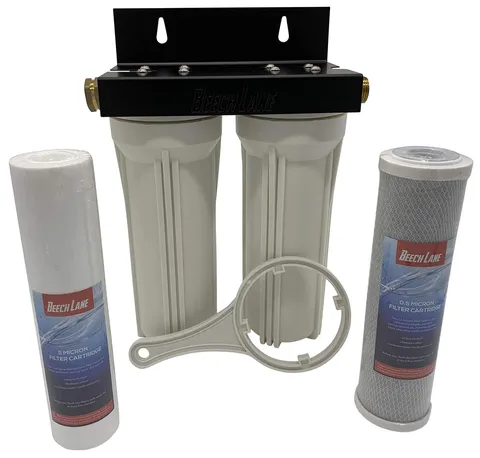
Beech Lane External RV Dual Water Filter System
Best ValueMid-range

2. Beech Lane External RV Dual Water Filter System

Beech Lane

$70–$105

A two-canister sediment-plus-carbon setup with lead-free brass fittings at a fraction of the big-name price. Replacement cartridges are cheap and standard-sized, which is what matters most when you filter every single day.

Best for: Park residents who want daily two-stage filtration without the premium price

5 micron sediment stage plus 0.5 micron carbon block, the same architecture as systems costing several times more · Lead-free brass fittings resist cross-threading and leaks better than plastic · Inexpensive standard-size replacement cartridges · Lifetime manufacturer warranty

No 0.2 micron absolute option, so it is not a bacteria barrier · Included mounting bracket is basic, and many owners end up building their own stand

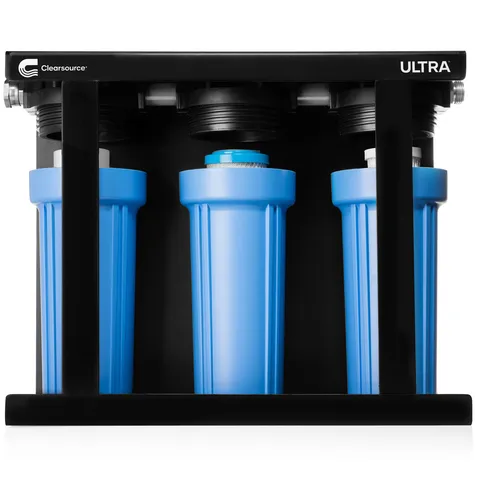
Clearsource Ultra RV Water Filter System
Best PremiumPremium

3. Clearsource Ultra RV Water Filter System

Clearsource

$550–$600

Adds a third VirusGuard stage rated for viruses on top of the sediment and carbon stages. If you fill from questionable park wells or travel where boil notices happen, this is the ceiling of hose-connected protection.

Best for: RVers on well-water parks or anywhere source water is genuinely suspect

Three stages ending in VirusGuard media rated against viruses, bacteria, and cysts · 4.5 gpm flow keeps usable pressure at the fixture · Stainless fittings and a rugged chassis built for permanent outdoor duty

About $600 before replacement filters · Third stage adds ongoing cartridge cost over the two-stage Premier · At 28 pounds it is a lot to wrestle in and out of a basement bay

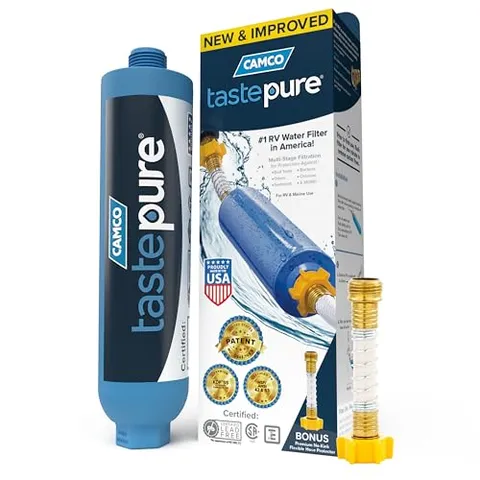
Camco TastePURE RV Water Filter (40043)
Best BudgetBudget

4. Camco TastePURE RV Water Filter (40043)

Camco

$18–$30

The default first filter for a reason: it screws inline on any hose, knocks out chlorine taste and odor, and costs about what a tank of propane does. It will not stop fine sediment or bacteria, and it does not claim to.

Best for: Weekenders and new RV owners who mainly want the chlorine taste gone

Around $20 and sold everywhere from Walmart to truck stops · GAC plus KDF media reduces chlorine taste and odor and inhibits bacterial growth inside the filter during storage · NSF certified and made in the USA · Included flexible hose protector takes strain off the spigot connection

Granular carbon is a coarse filter, so fine sediment passes through · Flow drops noticeably late in the season · Designed to be discarded after one camping season

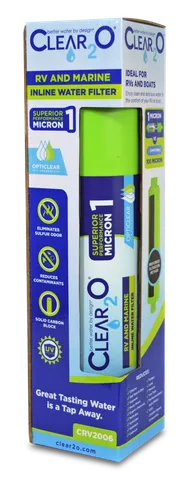
Clear2O RV and Marine Inline Water Filter (CRV2006)
Editor's PickBudget

5. Clear2O RV and Marine Inline Water Filter (CRV2006)

Clear2O

$20–$30

A true 1 micron solid carbon block in an inline stick body, dramatically tighter filtration than the granular carbon inside most $20 filters. Pair it with Clear2O's DirtGuard pre-filter on silty park water and it rivals canister setups.

Best for: Inline-filter users who want near-canister water quality without mounting anything

1 micron solid carbon block reduces fine sediment, lead, chlorine, and VOCs · Full-length block maximizes carbon contact time for better taste · Storage end caps included so it stays sanitary between trips

Tighter media means lower flow than looser granular inline filters · Clogs quickly on very silty water unless you add a sediment pre-filter

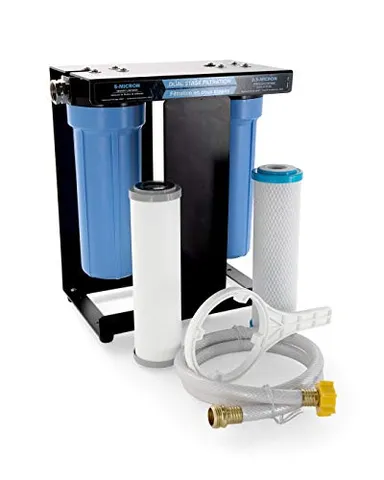
Camco EVO X2 Dual Stage RV Water Filter Kit (40639)
Mid-range

6. Camco EVO X2 Dual Stage RV Water Filter Kit (40639)

Camco

$150–$190

Camco's two-canister answer to the boutique systems: a sediment first stage feeding a KDF plus GAC second stage in a tool-free housing. It lands usefully between inline sticks and the $500 stainless rigs.

Best for: Seasonal travelers stepping up from inline filters without going full premium

True two-stage filtration with replaceable cartridges · Tool-free housing design makes cartridge swaps quick · Made in the USA with a wide dealer network for spares

At around $160 it is not far from where premium systems start on sale · Plastic fittings and housings rather than brass or stainless

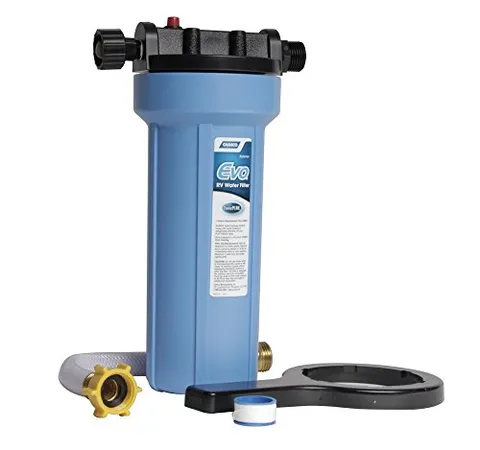
Camco EVO Premium RV Water Filter (40631)
Budget

7. Camco EVO Premium RV Water Filter (40631)

Camco

$25–$45

A single-canister kit with a 5 micron shell around KDF and GAC media, so it outfilters any inline stick while costing about the same as two of them. When the media is spent you swap a cartridge instead of tossing the whole unit.

Best for: Budget-minded RVers who want canister-grade filtration at inline-stick money

5 micron shell plus KDF and GAC media in one compact canister · Replaceable cartridge beats throwing away a whole inline filter · Includes housing, 12 inch extension hose, and the first cartridge · CSA lead-free certified to NSF/ANSI 372

Single stage, so heavy sediment shortens the carbon's life · Cartridge is rated for roughly one camping season

Waterdrop RV/Marine Inline Water Filter (2-Pack)
Budget

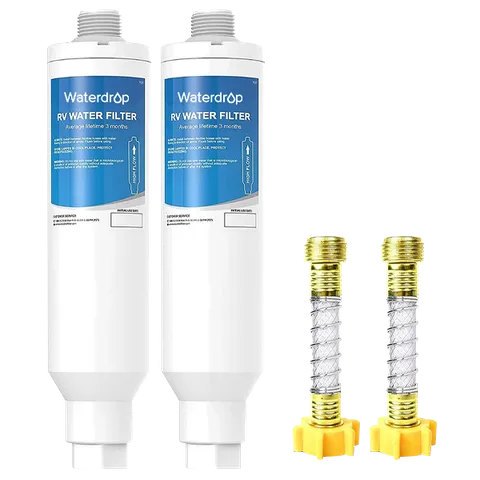
8. Waterdrop RV/Marine Inline Water Filter (2-Pack)

Waterdrop

$20–$28

The strongest of the cheap inline sticks: NSF certified, KDF plus GAC media, and higher flow than the category standard so tank fills stay quick. A two-pack costs about one dinner out and covers a full season with a spare.

Best for: Price-first buyers who still want an NSF-certified name on the label

NSF/ANSI 42 and 372 certified · Higher flow rate than most inline filters · Two-pack pricing keeps cost per season very low · Flexible hose protector included

Granular media, so fine sediment and pathogens pass through · Roughly 3 month service life per filter in daily use

GoBluTech AR3 3-Stage RV Water Filtration System
Premium

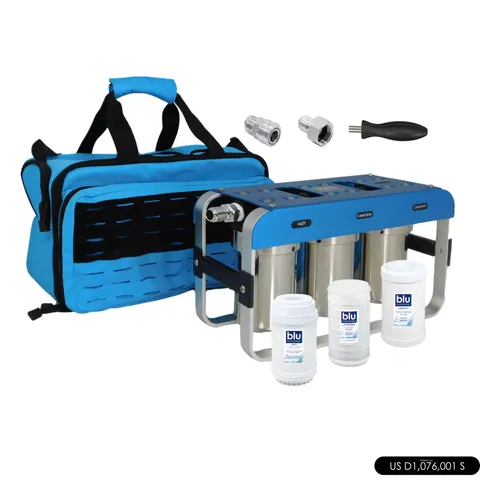
9. GoBluTech AR3 3-Stage RV Water Filtration System

Blu Technology

$450–$500

A veteran-owned alternative to Clearsource with a three-stage filter train in a road-ready powder-coated frame. The brand's softener and UV-C bundles let you grow the system later, which suits residents fighting hard park water.

Best for: Premium-tier shoppers who value an expansion path to softening and UV purification

Three-stage sediment, carbon, and fine-filtration train · Rugged powder-coated frame built for travel and outdoor mounting · Upgrade path to softener and UV-C purification bundles from the same maker

At about $500 it competes head-on with the Clearsource Premier · Smaller dealer and review footprint than the established brands

Clearsource Nomad RV Water Filter System
Premium

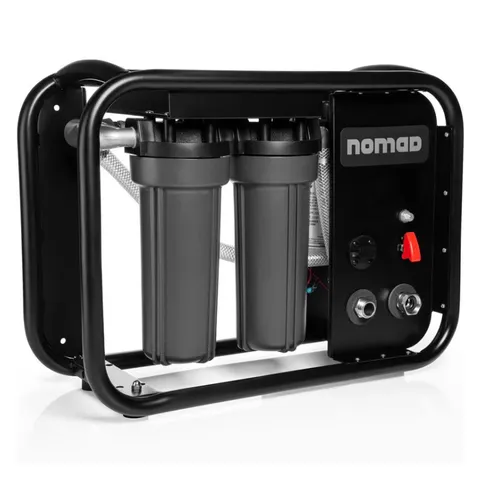
10. Clearsource Nomad RV Water Filter System

Clearsource

$850–$900

A filtration system with its own onboard pump that can pull from a spigot, a tank, or a lake and push clean water into your rig. Overkill for a full-hookup site, indispensable off the grid.

Best for: Boondockers and van-lifers filling from unpressurized or wild sources

Integrated pump draws water up 20 feet of rise and from 100 feet away · VirusGuard-class dual filtration covers bacteria, cysts, and viruses · Doubles as a fresh-tank filler where no pressurized spigot exists

At about $900 it is the most expensive option in this guide · Far more capability than a hookup-site resident will ever use

How we choose

We built this list by verifying every product against manufacturer pages and live retailer listings in September 2026, confirming current street pricing at Amazon, Walmart, and specialty RV retailers, and comparing manufacturer specifications on micron rating, NSF certification, flow rate, and replacement cartridge cost. We weighed those specs against owner feedback from RV forums and long-form reviews. Budget tier means inline disposables and small canister kits under about $50, mid tier means canister systems from $50 to $200, and premium means multi-stage systems from $450 up. Rankings reflect our overall recommendation for the typical RVer or park resident, balancing protection, flow, durability, and cost per season rather than price alone. No manufacturer paid for inclusion, supplied samples for this roundup, or saw the guide before publication. Retail links may earn us a commission, and that never influences position.

Common questions

Usually yes. Even treated municipal water picks up sediment and metallic taste from the park's own distribution lines, which are often decades old, and chlorine levels that taste fine from a house tap can be strong out of a campground spigot. A basic carbon filter fixes taste immediately, and a sediment stage protects your water heater, pump, and fixtures from grit.

The number is the size of particle the filter can catch, and smaller is tighter. A 20 micron granular filter catches coarse grit, 5 microns stops most visible sediment, 1 micron traps fine silt, and a 0.5 micron carbon block handles fine sediment plus taste. Bacteria and cysts need 0.2 micron absolute filtration, where absolute means every pore is verified at that size rather than an average. Only the premium tier in this guide reaches that level.

Inline stick filters last roughly 3 months of daily use, or one camping season of weekends. Canister cartridges vary by stage: sediment cartridges clog on whatever schedule your water dictates, sometimes monthly on silty well water, while carbon stages typically run 3 to 6 months. If flow drops noticeably at the faucet, the sediment stage is usually the culprit. Long-term residents should buy replacement cartridges by the multi-pack, since cheap refills are exactly where canister systems beat disposables.

Most will not, and the marketing can blur this. Carbon and KDF filters in the budget and mid tiers improve taste and inhibit bacterial growth inside the filter itself, but they are not a pathogen barrier. For actual bacteria and cyst removal you need 0.2 micron absolute filtration like the Clearsource Premier, and for virus-rated protection you need something like the Clearsource Ultra's VirusGuard stage. During a boil-water advisory, follow the advisory no matter what filter you own.

None of them, and it is worth being clear about that. Hardness is dissolved calcium and magnesium, which passes straight through sediment and carbon filters. What these filters do fix is the sediment, chlorine, and taste problems that usually ride along with hard well water. If scale on fixtures and in your water heater is the main complaint, you need a separate RV water softener, and brands like Blu Technology sell filter-plus-softener bundles for exactly that reason.

It depends entirely on how much water you run through it. For a few weekends a year, no, buy the Camco or Waterdrop stick and enjoy the trip. For full-time living the math changes: premium systems filter tighter, flow faster, and their per-cartridge cost over a year of daily use is competitive with burning through disposables. The protection difference is also real, since no inline stick stops bacteria. Think of the premium tier as plumbing infrastructure and the budget tier as a travel accessory.

Some links are affiliate links, and we may earn a commission at no extra cost to you. It never affects our rankings.

In your pocket

Take every campground with you.

Free, no account needed. Campground maps, multi-stop routes, and public lands in your pocket.

  • Every RV park and campground in your pocket

  • Multi-stop routes planned and saved

  • Public-land boundaries for boondocking

  • GPS tracking that keeps recording between coverage

The RV Park Hubs app dashboard

For operators

Run a park or campground?
Get on the map for free.

Claim your free listing for a branded page and a spot in the RV Park Hubs app, then add bookings and digital waivers whenever you’re ready. No setup cost.