Skip to content

Free Tool · No account required

How much solar does your RV need?

List what you run and where you camp, and the planner sizes the panels, batteries, inverter and charge controller, then checks it all against your roof. You get a parts list with a rough cost.

  • Real NREL sun data
  • Checks it fits your roof
  • Itemized parts estimate
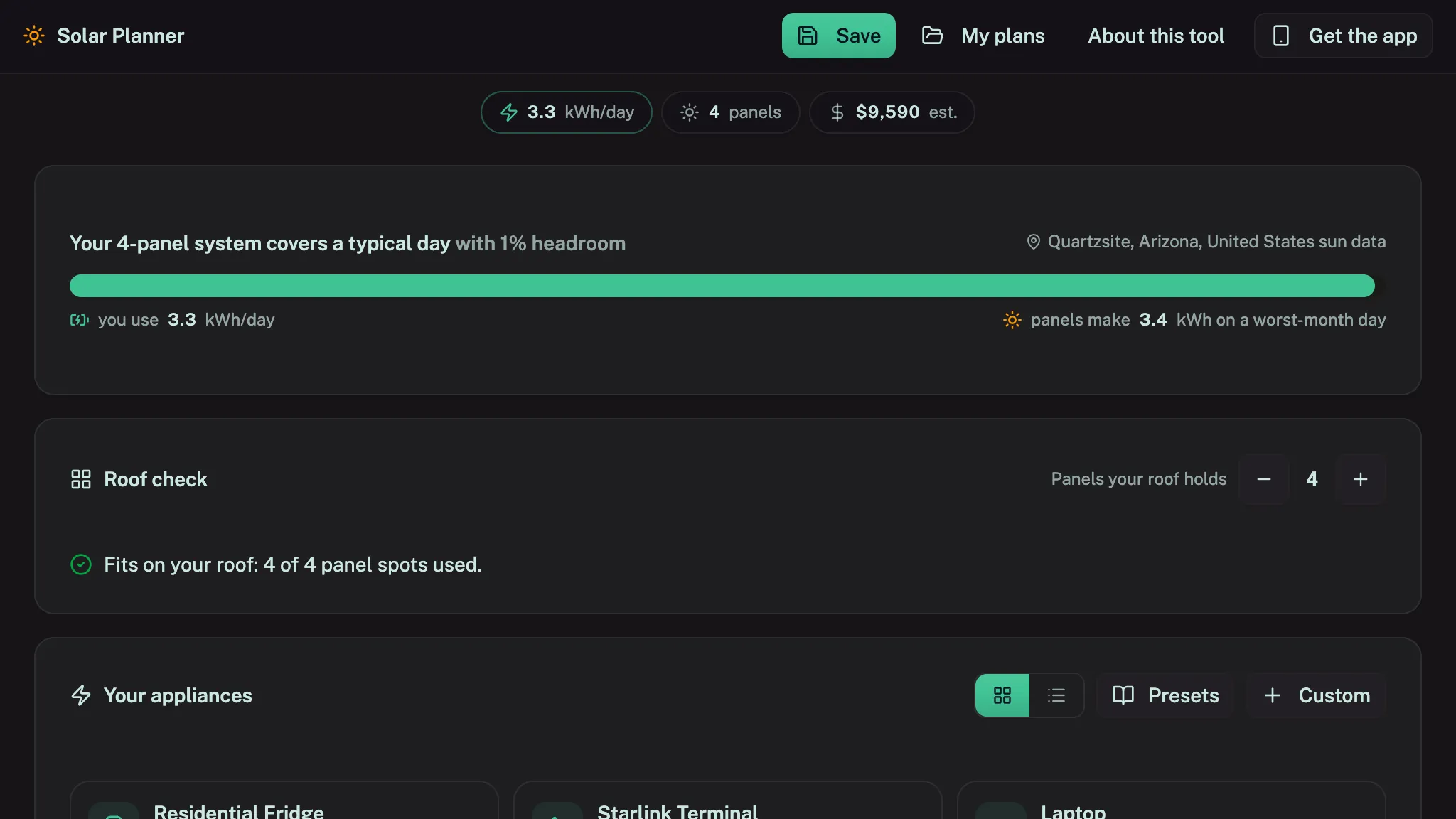
The RV solar planner: a full-time RV load of 3.3 kWh a day sized to a 4-panel array on Quartzsite, Arizona sun data, with a roof check showing all 4 panels fit on the roof, above the appliance list starting with a residential fridge, a Starlink terminal and a laptop
A real plan in the planner: a full-time RV running a residential fridge, Starlink, a CPAP and lights at 3.3 kWh a day, sized to 4 panels on Quartzsite sun data, which fits the roof.

How it works

How the sizing works

  1. 1

    List what you'll run

    Pick from RV presets like a 12V fridge, roof vent fan, water pump, furnace fan, CPAP and Starlink, or add your own. Watts × hours × quantity adds up to your daily use and peak load.

  2. 2

    Set your rig and where you camp

    Choose 12V, 24V or 48V, your battery chemistry, your panel size and how many panels your roof holds. Pick the place you camp most to pull its month-by-month sun from NREL.

  3. 3

    Read the sizing

    Panels are sized for that spot's darkest month, with the battery bank, inverter and charge controller matched to real gear for a starting budget. The roof check tells you whether it all fits. Your inputs stay in this browser.

Sun data from NREL PVWatts. Everything runs in your browser, with no account and no quote form.

Common questions

RV solar questions

It depends on what you run and where you camp. List your appliances and the planner totals your daily use, pulls month-by-month sun from NREL PVWatts for the place you camp most, and sizes the array for that spot's darkest month. Then it checks the answer against the panels your roof can hold.

Set how many panels your roof holds and the planner shows how much of a worst-month day they cover. When that falls short it tells you by how much and names your biggest load, so you can trim it, charge from the engine while you drive, or carry a portable panel for camp.

The battery bank is sized from your daily use, the cloudy days you want to ride out, your system voltage (12V, 24V or 48V) and your battery chemistry (LiFePO4, AGM or lithium-ion). The inverter is sized from everything you might run at once.

It can, but it takes a lot. A rooftop air conditioner draws roughly 1,300 to 1,500 watts while it runs, so a few hours a day can need more panels than most roofs hold. Add it in the planner and the roof check shows how far short you are.

Yes. The RV Park Hubs solar planner is free and runs entirely in your browser, with no account, no email wall and no quote form.