Setting Up Your Mail and Legal Address
Moving into full-time RV park living solves the housing cost problem but creates an immediate practical crisis: you no longer have a fixed mailing address. Without one, you can't register your vehicle, renew your driver's license, file taxes, vote, maintain a bank account, or prove residency for insurance purposes. This isn't a minor inconvenience, it's a legal and financial necessity that trips up more new full-time residents than any other single issue. The solution requires three coordinated steps: choosing a domicile state, establishing a mail service address, and updating all your legal documents. Done right, it takes a few hours and costs less than a month's campsite fee. Done wrong, or delayed, it creates months of headaches and potential complications with tax authorities and vehicle registration.
Why Mail and Domicile Matter for RV Park Living
Every legal entity in the United States requires a physical address. Your state of domicile determines your tax obligations, vehicle registration rules, driver's license validity, and insurance eligibility. When you park permanently or semi-permanently at an RV community, you're becoming a long-term resident of that location, which is why establishing proper domicile documentation matters more than it does for a nomadic RV traveler passing through states.
Your domicile state is where you'll file income taxes and vehicle registrations. It's the jurisdiction that claims you as a resident for legal purposes. If you skip this step and continue using an old out-of-state address, you risk filing taxes incorrectly, getting vehicle plates that expire without renewal notices reaching you, and creating gaps in your voter registration. Tax authorities increasingly flag multi-state RV residents who haven't formalized their domicile, and insurance companies regularly deny claims when they discover your policy was registered at an address you haven't lived at in years.
The practical challenge is that mail delivery to your RV site may be unreliable, especially if you're in a remote park or move seasonally. Even parks with mail service sometimes mishandle packages or distribute mail inconsistently. This is why you need a formal mail service address separate from your campsite address. It's your anchor point for all official correspondence, even while your physical location changes or shifts within the park.
Choosing a Domicile State
Your domicile choice is primarily driven by tax optimization and residency ease. The nine states with no personal income tax (Alaska, Florida, Nevada, New Hampshire, South Dakota, Tennessee, Texas, Washington, and Wyoming), are the default choice for full-time RV residents. (New Hampshire finished repealing its tax on interest and dividend income at the start of 2025, so it now has no personal income tax at all.) These states won't tax your wages, pensions, or Social Security, saving retirees and remote workers thousands annually. Among these, Florida, Texas, and South Dakota are the most practical because they have straightforward residency requirements, RV-friendly cultures, and affordable mail service addresses. (Note that Montana, sometimes mistaken for a no-income-tax state because it has no sales tax, does levy a state income tax of roughly 4.7–5.9%.)
Beyond taxes, understand how residency days actually work, because this is widely misunderstood. There is no general rule requiring you to spend 183 days in a state to establish domicile there. In fact, the popular RV domicile states have minimal or no presence requirements: Florida asks for zero days, and South Dakota needs only a single overnight stay (keep the campground or hotel receipt as proof). The 183-day figure runs the other direction. It's the "statutory residency" trap that high-tax states use to pull you in as a taxpayer: if you spend more than 183 days in a high-tax state, it can claim you as a resident and tax your income even if your domicile is elsewhere. So the days rule matters most for snowbirds splitting time between two parks: stay under 183 days in any high-tax state you visit, and document your days carefully with receipts, photos, and RV park registrations to defend your domicile claim if audited.
Vehicle registration in your domicile state carries implications you'll live with daily. Montana, for example, is genuinely cheap to register (no sales tax, and permanent registration for older vehicles), which appeals to people holding older RVs, though it does levy an income tax, so it's rarely the full-timer's domicile of choice. Costs vary widely and cheap-to-register is not the same as no-income-tax: Nevada, despite having no income tax, has a value-based vehicle tax that makes registration relatively expensive. Texas and Florida have moderate initial registration and straightforward renewal processes. Check your domicile state's specific rules for RV registration: some treat motorhomes as vehicles, others as personal property, with different fees accordingly.
Snowbirds especially should verify whether your chosen domicile state recognizes split residency. Some states will tax income earned while you're within their borders, even if you claim domicile elsewhere. Consulting a tax advisor who specializes in RV residency is worth the cost if your income situation is complex, though most full-time residents find the straightforward no-income-tax states simplest to navigate.
Setting Up Mail Forwarding and a Legal Address
Your mail service address is your legal domicile address on all official documents. You have a few primary options: a dedicated RV mail-forwarding service, a private mailbox service (UPS Store, Mailboxes Etc.), or occasionally the RV park itself if it offers a formal mailing address.
The canonical full-timer solution is a dedicated RV mail-forwarding service, and the oldest and largest is Escapees Mail Service, run by the Escapees RV Club since 1985. For roughly $95–$135 per year (plus a small one-time enrollment fee and a postage deposit), it gives you a real street address in your choice of Texas, Florida, or South Dakota, the standard domicile trio, and pairs it with package acceptance, mail forwarding on request or on a schedule, and online account management. Because the service is built specifically around RVers establishing domicile, the address it provides is designed to be accepted by DMVs, tax authorities, and financial institutions in that state. Other RV-oriented services (Traveling Mailbox, My RV Mail, and similar) work the same way; the key is that the address sits in your chosen domicile state.
USPS mail forwarding is something different, and it's worth correcting a common misconception: standard USPS forwarding has no per-day charge. A standard Change of Address is free when filed in person, or $1.25 as a one-time online identity-verification fee, and it forwards mail from an old address to a new one for up to one year. (USPS does sell a per-period product (Premium Forwarding Service, which bundles all your mail into a weekly Priority Mail shipment for about $29.70 per week plus enrollment), but that's a convenience option, not a domicile solution.) Standard forwarding is useful for transition periods but doesn't solve the core problem: you still don't have an official address where entities can mail you directly. USPS forwarding also shows on background checks and some applications, which can raise questions. Use it as a temporary bridge while you establish your permanent address, not as your long-term solution.
A private mailbox service (PMB) rents you a box and a street address at a commercial location. The address format is "Suite 123" instead of "Box 456," which matters legally, many government agencies and financial institutions won't accept PO boxes, but they will accept suite addresses. A PMB costs $15–40 per month depending on the service tier, location, and whether you add package handling or mail scanning. This is your best option for reliability and widespread acceptance.
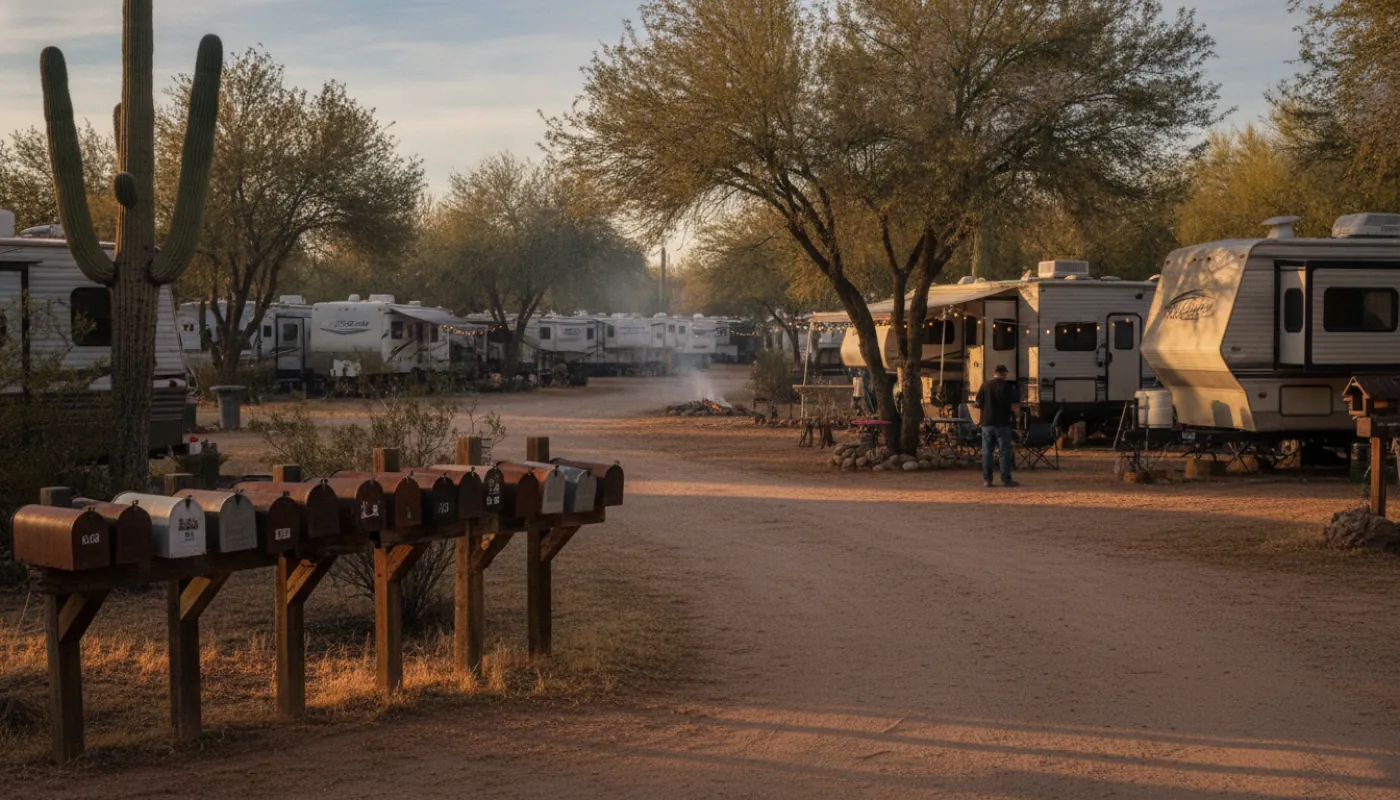
Some RV parks, especially those catering to full-time residents, offer mail service through their office. The address becomes "123 Park Drive, Park Office" or similar. This is convenient if it's available and the park staff is reliable, but it creates a dependency on the park's infrastructure and employee turnover. A few parks assign PO boxes through their local post office, which is better for your security but still less reliable than a dedicated mail service.
Choose a mail service in a state where you have legal domicile. Setting up a PMB in Florida while claiming domicile in Texas raises red flags with tax authorities and registration offices. The address on your ID, vehicle registration, and voter file should all match your domicile state's mail address.
Establishing Your Legal Domicile Documents
Once your mail service address is active, update your documents in this order: vehicle registration, driver's license, voter registration, then everything else. Your state's DMV handles the first two; your county clerk's office handles voter registration. Start with vehicle registration because it's typically the slowest process and creates the baseline documentation for other agencies.
Contact your domicile state's DMV and request a vehicle registration renewal or address update. You'll need your current registration, VIN, proof of insurance, and your new address documentation from your mail service. Most states will process this by mail, which is ideal for RVers. It typically takes two to four weeks. Once your registration is updated, you have legal proof of residency in your new state.
Your driver's license renewal uses the same new address. DMV offices have online portals for renewals in many states; Florida and Texas both allow mail-in renewals. You'll need the vehicle registration or a utility bill showing your name and the new address. Getting your license renewed immediately matters because you'll need it for banks, insurance, and other verification purposes.
Voter registration is often overlooked but is a powerful piece of residency documentation. Register with your county clerk or through your state's online voter portal, using your new address. This shows you intend to make the state your permanent home, which strengthens any residency claims later.
Update your insurance, bank accounts, credit cards, and subscription services to your new address. Insurance especially, your homeowner's or renter's policy coverage depends partly on your stated residence. Medical providers, utilities, and any services billed to you should also use your new address so important notices reach you reliably.
Managing Mail While You're Living Full-Time
Even with mail forwarding set up, you'll need a system for handling mail logistics. Most mail service providers offer online dashboards where you can view incoming mail, request scans of important documents, or hold mail for batch pickup. Use this feature liberally. Instead of collecting mail continuously, batch it up monthly or quarterly and arrange a pickup or reroute shipment to your current park.
Critical documents (tax records, medical records, legal papers), should be scanned or converted to digital whenever possible. Set up paperless billing for utilities, insurance, subscriptions, and financial accounts. This cuts the volume of physical mail you receive dramatically and gives you instant access to important documents from anywhere. A few critical items will still arrive on paper: tax forms, legal notices, and certified mail.
When you're planning to move locations or leave for an extended period, use USPS mail hold service for your mail service address. Hold mail for the dates you'll be away, then pick it up when you return to the region. This prevents mail from accumulating and getting lost.
Keep a forwarding list of entities that matter: your employer, your bank, your insurance companies, loan servicers, and healthcare providers. Update them manually with your new address rather than relying on USPS forwarding alone. Some, particularly banks and government agencies, require address verification before processing mail-forwarding requests.
A checklist of mail-critical accounts: checking and savings accounts, investment accounts, credit cards, insurance (auto, health, renters), employer records, tax service providers, healthcare providers, utilities, subscriptions, and voter registration. Go through each and confirm they have your new address. For accounts you rarely use, this step is easy to skip, but missing mail from your bank or loan servicer can create serious problems.