For long-term RV park residents, electrical service capacity is not an abstract utility spec, it's a daily constraint that either works smoothly or forces uncomfortable choices. The difference between 30-amp and 50-amp service fundamentally changes what you can run simultaneously, how you heat or cool, and whether seasonal electricity demand spikes break your routine. Parks that know this distinction invest in pedestal upgrades; residents who understand it make smarter site selection decisions. This guide clarifies the practical gap between the two, why it matters for permanent and semi-permanent living, and how to evaluate which setup meets your actual needs.
Understanding RV Electrical Service Basics
RV park pedestals deliver power through a standardized connector, either a 30-amp or 50-amp receptacle, but the difference runs deeper than the plug shape. A 30-amp service delivers 120 volts at 30 amps, yielding a maximum of 3,600 watts of simultaneous draw. A 50-amp pedestal delivers 240 volts (split-phase) at 50 amps, supporting a maximum of 12,000 watts. The voltage difference is crucial: 50-amp service runs on two legs of 120 volts each, allowing higher-amperage draws on individual circuits without exceeding the amp limit.
The connector types enforce these differences. A 30-amp receptacle is a three-prong design that physically won't accommodate a 50-amp plug, and vice versa. This built-in incompatibility is intentional, it prevents someone from attempting to draw 50-amp demand from a 30-amp pedestal, which would trip breakers or worse. Understanding this constraint is important when evaluating a park's infrastructure or planning a long-term stay. If a park only has 30-amp pedestals wired to its infrastructure, upgrading individual sites to 50-amp requires upgrading the distribution lines and main transformer capacity, not just swapping out receptacles. That work is expensive and often beyond a park's immediate budget.
Why 30-Amp Service Creates Real Limits for Long-Term Residents
A 30-amp pedestal sounds adequate until you live with one year-round. The 3,600-watt ceiling means you must actively manage simultaneous loads. Running the air conditioner while using an electric water heater, microwave, and hair dryer forces a choice, something shuts off or the breaker trips. In winter, a 30-amp heat pump or resistance heating takes most of your available power, leaving little headroom for cooking or laundry. Seasonal transitions are especially tight: a park in the Southwest might see weeks in May or September when daytime heat demands AC while morning chill tempts a small heater.
For residents who work from home, the constraint becomes more than inconvenient. A laptop charger, monitor, and router typically draw 100–150 watts, affordable on 3,600 available. But add a videoconference day when the microwave runs, laundry is scheduled, and the RV's refrigerator cycles on, and you're at 2,800–3,200 watts with no buffer. Internet outages during peak loads (triggered by voltage sag when the breaker strains) break work days. Guests adding a space heater to a bedroom convert a routine evening into a load-management crisis.
Long-term residents in 30-amp sites report similar workarounds: scheduling laundry for off-peak hours, using a convection oven instead of the built-in microwave, keeping supplemental heaters off the grid, or drying hair before the AC runs. None of these are failures on the park's part if the site was never promised 50-amp capacity. But they reveal why residents who can relocate often do, or why they stay in parks that have invested in 50-amp infrastructure.
The 50-Amp Advantage: Power Without Compromise
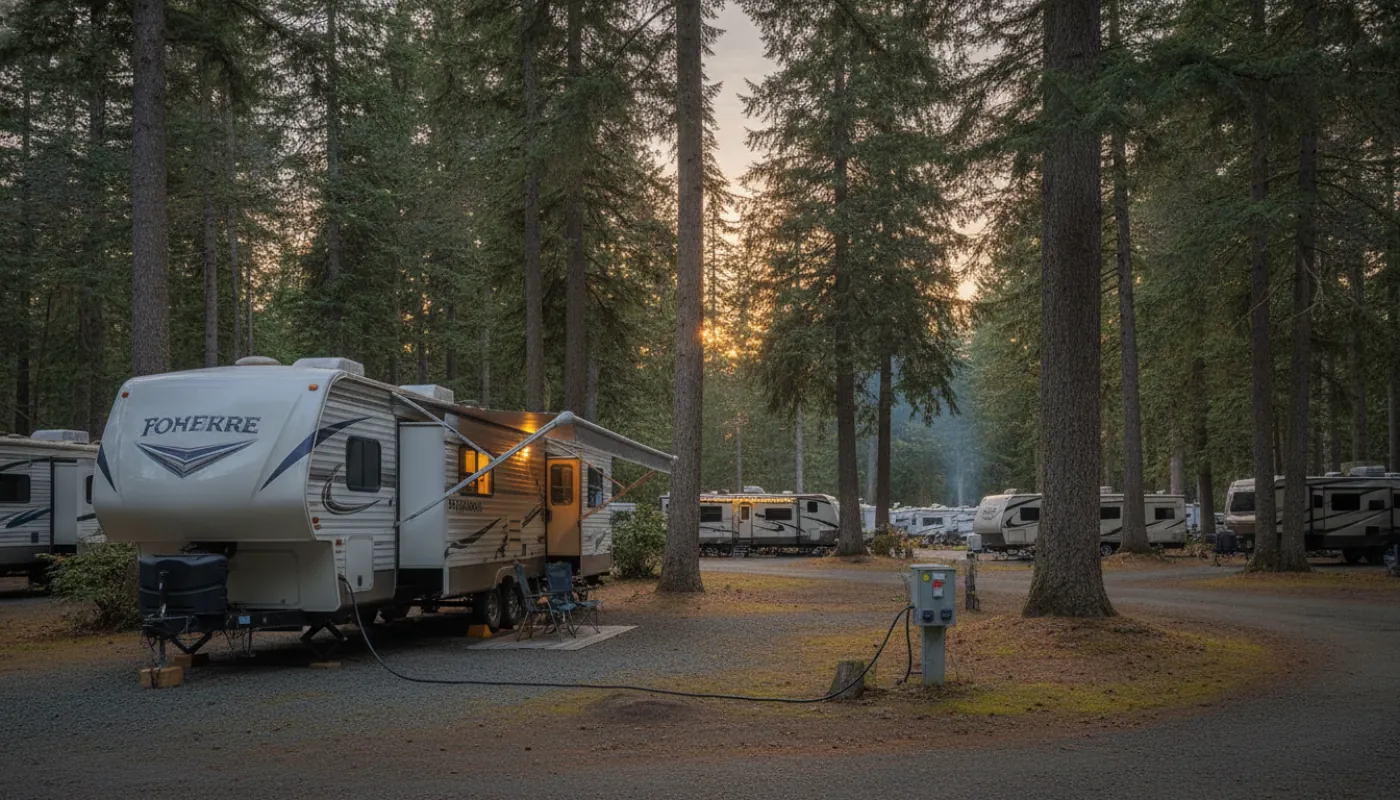
A 50-amp pedestal with 12,000 watts of available power changes the equation entirely. You run the air conditioner and the water heater simultaneously, use a real convection oven for cooking, and dry hair without checking load gauges. The 240-volt split-phase design gives you two independent 120-volt legs, so the RV's load center can spread its circuits (air conditioners on one leg, water heater and kitchen on the other), instead of stacking every high-draw appliance onto the single 120-volt circuit that 30-amp service forces. Residents report the psychological relief alone is worth the infrastructure difference: living feels normal, not like a permanent energy triage exercise.
For work-from-home residents, 50-amp service eliminates an entire category of stress. A sump pump, well pump, or sewage ejector can run during business hours without tripping the main breaker. Laundry happens whenever convenient. A guest's space heater is a minor convenience, not a load-management crisis. Retirees who spend full winters in the same park can run space heaters or heat pumps in bedrooms without sacrificing other amenities.
The practical ceiling of 12,000 watts is still a constraint (run two rooftop air conditioners, an electric water heater, a space heater, and the microwave all at once and you can still approach it), but that ceiling is high enough that it rarely forces operational choices. Residents who know their RV's actual peak draw (typically 2,500–6,000 watts for mid-size travel trailers and smaller motorhomes) find themselves with 6,000–9,000 watts of headroom, a margin that allows normal life without planning.
Evaluating Your RV's Actual Electrical Demands
Before choosing between sites or requesting a park upgrade, determine what your RV can actually draw. Check your RV's electrical panel or owners manual for the amperage rating, this is your first hard constraint. An RV designed for 30-amp service cannot safely use more than 3,600 watts; its internal wiring and breakers won't support it. If you own a 50-amp RV (motorhome, large travel trailer, or fifth wheel), you can only use a 50-amp pedestal; a 30-amp site requires an adapter and limits you to 30-amp capacity regardless.
Beyond the RV's design, map your typical simultaneous loads. What appliances do you run on a typical day? If you're full-time or semi-permanent, include heating in winter or cooling in summer, refrigeration, water heater, any space heaters or window units, and incidental use (laundry, cooking, charging devices). Most RVs with a 30-amp service rating (travel trailers, Class B motorhomes, small Class C rigs), have a peak draw under 3,000 watts under normal use. Larger Class A motorhomes and many fifth wheels are rated for 50-amp service and peak at 5,000–8,000 watts.
The goal is honest accounting: if your RV is 30-amp rated and your typical load is 2,000 watts, you have 1,600 watts of headroom and a 30-amp site works. If your RV is 50-amp rated and your winter heating needs 6,000 watts while you're working from home, a 30-amp site becomes impossible. Conversely, if you're considering a long-term park without 50-amp infrastructure, honestly evaluate whether a 30-amp service genuinely matches your needs or whether you'll spend the next few years managing breaker trips and compromises.
Site Selection and Park Infrastructure Planning
For parks managing long-term or seasonal resident bases, the electrical infrastructure decision significantly affects retention and competitiveness. A park that upgraded to 50-amp pedestals across its long-term section reports less resident turnover and higher monthly-rate stability. Parks that haven't upgraded field inquiries from long-term prospects: "Do you have 50-amp service?" If the answer is no, prospects often look elsewhere, especially in regions with cold winters or hot summers where heating and cooling loads are non-negotiable.
Upgrading an existing park from 30-amp to 50-amp is a capital-intensive project. It requires new main distribution infrastructure, potentially a larger transformer, new underground or overhead lines to each pedestal, and new pedestals with 50-amp receptacles. Costs vary widely by park size, terrain, and local labor rates, but projects often run $10,000–$50,000 or more depending on scope. For parks considering this investment, a phased approach is common: upgrade the long-term section first, leaving transient areas at 30-amp capacity while demonstrating to potential long-term residents that the park is making infrastructure commitments.
For residents evaluating a long-term or permanent move to a park, ask directly: "Which pedestals are 50-amp?" Visit during your intended season (summer if you depend on AC, winter if you use heat) and test whether the service matches your needs. A park that can only offer 30-amp service is not "inadequate", it's appropriately honest. But it should be your informed choice, not a surprise six months into your stay.
Protect Your Rig: Surge and Pedestal Safety
Whichever service you choose, the pedestal itself is the hazard most long-term residents underestimate. Older or hard-used park pedestals are frequently miswired (an open ground, reversed polarity, or a hot-neutral swap), and a long-term rig sits on that same pedestal for months. A basic surge protector only catches spikes; what you actually want is a full Electrical Management System (EMS), which continuously checks for low or high voltage, open grounds, and miswiring and cuts power to your rig before a fault damages appliances or creates a shock hazard. Buy the one that matches your service, 30-amp or 50-amp, and consider a hardwired unit for a stationary long-term site so it can't be unplugged or walk off. On a multi-month stay it pays for itself the first time a summer brownout drops the park's voltage.
Practical Next Steps: Choosing Your Site
The final decision depends on three factors: your RV's service rating, your typical electrical load, and the park's available infrastructure. If your RV is 30-amp rated and your winter or summer loads stay below 3,000 watts, a 30-amp site is perfectly adequate. If your RV is 50-amp rated, you need a 50-amp pedestal to use it properly. If you're uncertain about your loads, request a 50-amp site if available; you can always use less, but you cannot safely use more than your RV is designed for.
For park operators, the investment in 50-amp infrastructure pays dividends in long-term resident stability. For residents, the $15–$30 monthly premium for a 50-amp site is worth the practical freedom and confidence that you won't manage electrical constraints every season. Electrical service is not glamorous infrastructure, but it is foundational to whether long-term RV living feels like a choice or a compromise.